Rafael Berger · 18 October 2026
Coastal Breezes Transport Scent Molecules from Seaside Wildflowers to Inland Habitats
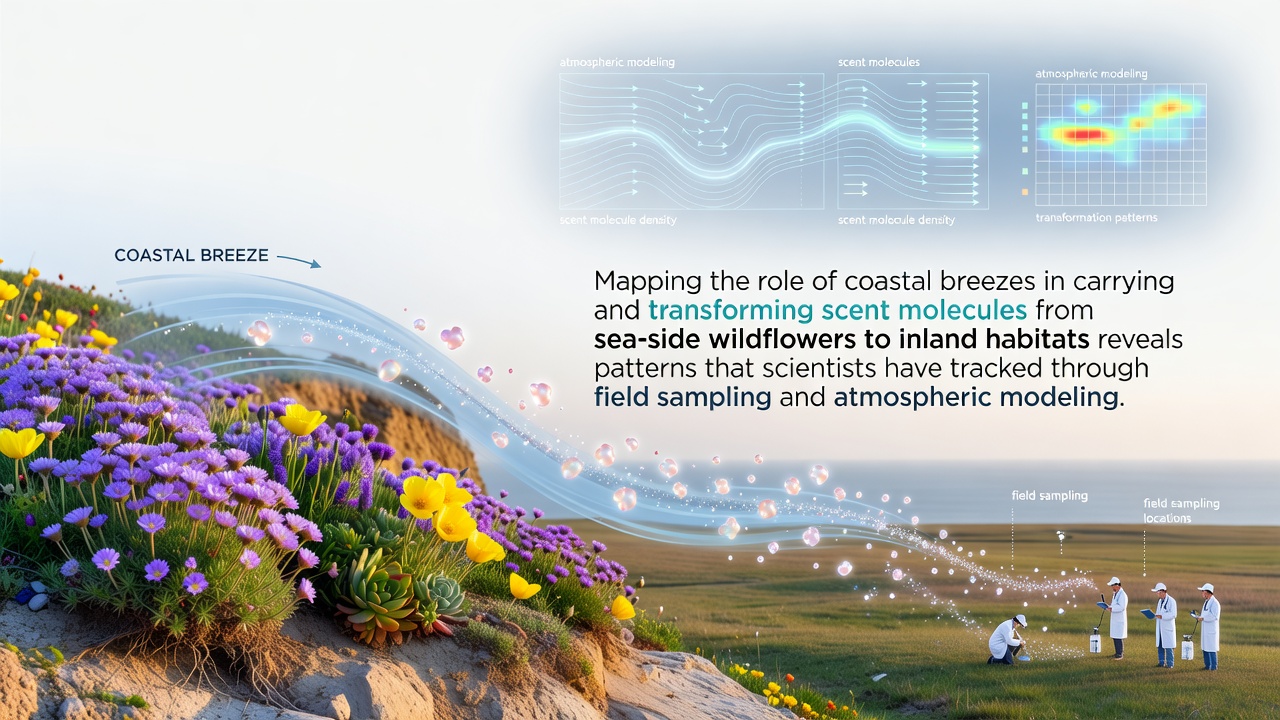
Scientists map the movement of scent molecules released by seaside wildflowers as coastal breezes carry these compounds inland where atmospheric conditions alter their composition and concentration over distance. Field sampling campaigns combined with atmospheric modeling have documented consistent patterns in how monoterpenes and sesquiterpenes travel from source populations of species such as sea thrift and coastal lavender. Data collected along transects show that wind speed and humidity gradients determine the rate at which these volatile organic compounds disperse and undergo oxidation.
Atmospheric Pathways and Molecular Stability
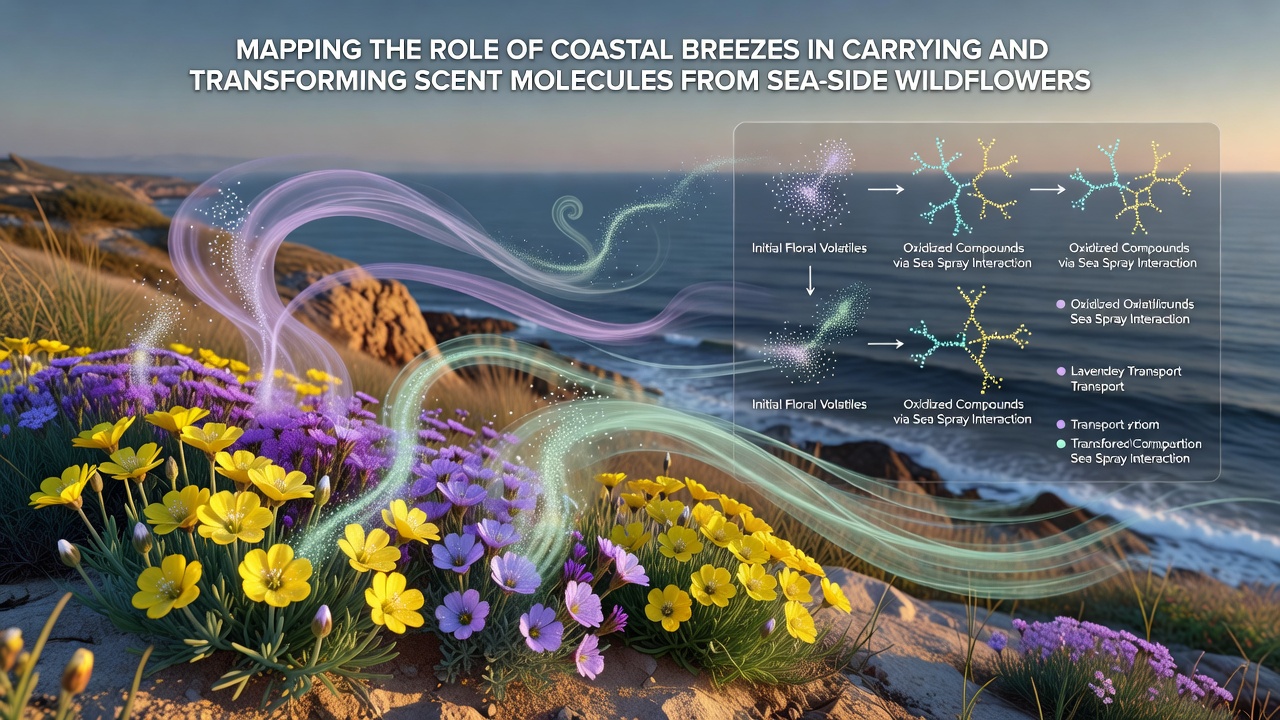
Breezes generated by temperature differences between land and sea create predictable onshore flows that peak during daylight hours and carry fragrance compounds several kilometers inland before turbulent mixing dilutes them. Researchers have measured peak concentrations of linalool and beta-caryophyllene at distances up to eight kilometers from the shoreline during stable morning conditions while noting rapid declines after midday when convective activity increases. Oxidation reactions initiated by hydroxyl radicals and ozone transform many of these molecules into secondary products such as pinic acid and nopinone which then deposit onto vegetation or soil surfaces farther inland.
Field Sampling Techniques and Data Collection
Teams deploy solid-phase microextraction fibers and proton-transfer-reaction mass spectrometers at fixed stations spaced at one-kilometer intervals from the coast to capture temporal and spatial gradients in scent profiles. Sampling protocols conducted in multiple coastal regions during spring and summer seasons reveal that emission rates from wildflower patches correlate strongly with solar radiation and soil moisture levels while transport efficiency depends on boundary-layer height. Continuous measurements recorded between 2024 and 2026 provide baseline datasets that atmospheric chemists use to validate dispersion models.
Modeling Approaches and Predictive Patterns
Atmospheric models incorporating large-eddy simulation and chemical transport modules simulate how sea-breeze fronts interact with floral volatile plumes and forecast concentration fields under varying meteorological scenarios. Outputs from these models match field observations when parameters for surface roughness and vegetation uptake are calibrated using local topography data. One study published in 2025 demonstrated that inclusion of diurnal wind shifts improved prediction accuracy for inland scent arrival times by 27 percent compared with simpler advection schemes.
Additional campaigns scheduled for October 2026 will expand sampling networks to include nocturnal land-breeze events that return modified compounds toward the coast and allow researchers to quantify bidirectional exchange. These efforts build on earlier work conducted by European and North American research groups that established the foundational chemistry of floral volatile oxidation during transport.
Observed Ecological and Chemical Interactions
Transformed scent molecules reaching inland habitats interact with resident plant communities and pollinator populations in ways that alter local chemical signaling networks. Measurements indicate that certain oxidation products persist longer than parent compounds and may influence herbivore deterrence or microbial activity in soil layers downwind of source sites. Data from sites in both Mediterranean and temperate coastal zones show that the ratio of oxygenated to non-oxygenated terpenes increases steadily with distance from the shoreline under typical daytime breeze conditions.
Integration of Observational and Computational Methods
Researchers combine high-resolution wind profiler data with real-time chemical sensors to refine source-receptor relationships and identify how micro-topographic features channel or disperse scent plumes. Validation exercises compare model outputs against independent datasets collected by government environmental agencies in Australia and Canada where similar coastal-inland gradients exist. These cross-regional comparisons highlight consistent roles for sea-breeze circulation in shaping the spatial extent of floral chemical signals.
Conclusion
Continued mapping of coastal breeze transport pathways supplies quantitative information on how floral scent molecules move and change before reaching inland ecosystems. Field measurements and atmospheric simulations together establish reproducible patterns that connect emission sources with receptor sites across varying distances and meteorological regimes. Future sampling rounds planned for October 2026 will extend these records and support refined models that incorporate additional chemical and physical variables.